
A New Savings Era: What It Means for Investors and Markets?
India is quietly undergoing a major financial transformation. For decades, household savings were dominated by physical assets like gold and real estate. Today, that pattern is shifting steadily toward Financial Instruments, and this change is reshaping the entire capital market ecosystem.
ENGLISHTOP POSTS
भाषा बदलने के लिए यहां क्लिक करें
A recent Business Standard report highlights how this structural shift is creating long-term growth potential for Asset Management Companies (AMCs) and market infrastructure institutions such as stock exchanges, depositories, and registrars. The key driver behind this transition is not speculation or short-term enthusiasm; it is the increasing discipline of Indian households in formal investing.
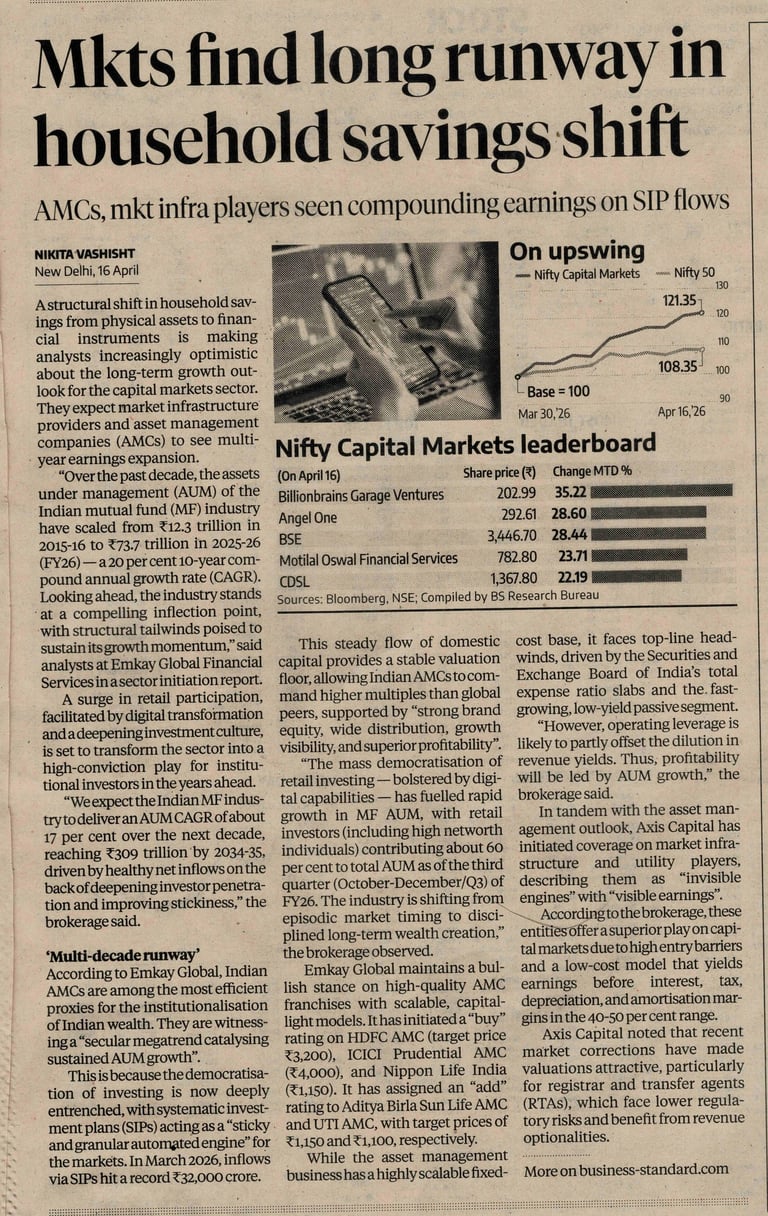
One of the most striking developments is the rapid growth of Assets Under Management in the Mutual Fund Industry. Over the last decade, the Industry has expanded sharply, supported by digital access, wider awareness, and growing participation from retail investors. This signals that saving is no longer just about preserving wealth but also about participating in the country’s economic growth.
At the centre of this shift is the rise of the SIP, which has become one of the most popular tools for structured investing. Unlike traditional lump-sum investing, systematic investing encourages consistency and reduces dependence on market timing. In fact, the article notes that SIP inflows touched a record ₹32,000 crore in March 2026, showing how deeply embedded this habit has become.
This change is important not only for investors but also for the markets themselves. Regular domestic inflows create a more stable foundation for stock market valuations. When more money enters markets steadily through monthly investments, volatility reduces, and reliance on unpredictable foreign flows can decline. This strengthens the resilience of the Indian Stock Market, especially during global uncertainty.
Another important takeaway is the growing role of retail investors in the overall market structure. Retail and high-net-worth individuals now contribute a major share of the total managed assets. This indicates that the market is no longer driven mainly by institutions; everyday investors are becoming meaningful participants. As a result, the focus is shifting from short-term market timing to long-term wealth creation.
This evolution also affects businesses that support the financial system. Market infrastructure companies - Stock Exchanges, Depositories, and Transfer Agencies- benefit when more investors enter the system. Their business models often have high entry barriers, stable operating structures, and strong profit margins because they act as the backbone of trading, settlement, and investor recordkeeping.
For the average investor, this new era brings an important lesson: understanding What is Investment is becoming essential, not optional. Investment is no longer restricted to a small segment of society. With technology enabling easier access, individuals are increasingly expected to take responsibility for building financial security through disciplined planning.
This also increases the relevance of education and advisory channels. A Mutual Fund Distributor and other financial intermediaries play a critical role in spreading awareness, improving access, and guiding first-time investors toward appropriate products. But education must remain the foundation, especially as people search online for terms like Mutual Funds, Mutual Funds in India, Best Mutual Funds in India, and Top Mutual Funds without fully understanding risk, return cycles, and suitability.
In many ways, this savings shift is also changing how people interpret Today's Stock Market. Market movements may still appear unpredictable daily, but the underlying system is becoming stronger because household participation is rising consistently.
The larger story is not about quick gains. It is about India’s gradual movement toward financial maturity, where saving habits evolve into Investing habits, and investing becomes a long-term economic engine. The runway ahead is long, and its impact will likely be felt not only in markets but also in how future generations build wealth through tools like SIP Investment.
Disclaimer
Mutual fund investments are subject to market risks. Past performance is not indicative of future returns. This blog is intended solely for education and awareness and should not be treated as investment advice or a recommendation to buy or sell any mutual fund scheme. Investors are advised to read all scheme-related documents carefully and consult a Mutual Fund Distributor before making any investment decisions.
Click here to connect with an AMFI-Registered Mutual Fund Distributor.