FY26 Mutual Fund Inflow Trends: A Strong Reminder Why Diversification and Guidance Matter
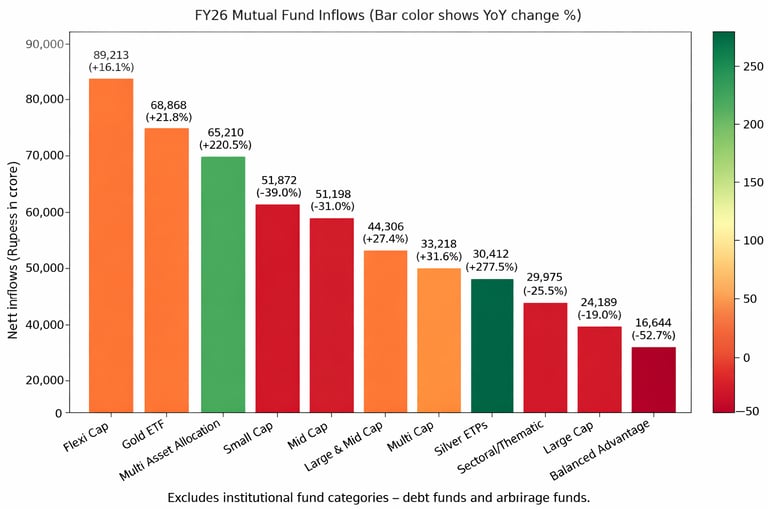
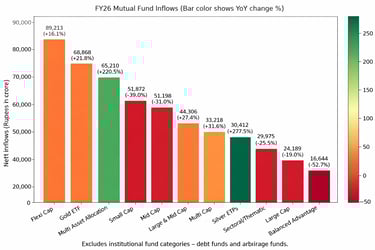
A recent report on FY26 Mutual Fund Inflows has revealed a noticeable shift in investor preference. Flexi-cap funds have emerged as the most popular mutual fund category, while Mid-cap and Small-cap inflows have declined sharply compared to the previous year. At the same time, categories like Gold ETFs and Multi-Asset Allocation funds have witnessed strong growth in inflows.
ENGLISHTOP POSTS
भाषा बदलने के लिए यहां क्लिक करें
A recent report on FY26 Mutual Fund Inflows has revealed a noticeable shift in investor preference. Flexi-cap funds have emerged as the most popular Mutual Fund category, while Mid-cap and Small-cap inflows have declined sharply compared to the previous year. At the same time, categories such as Silver ETFs and Multi-Asset Allocation funds have seen strong inflow growth.
This data is not just news; it is an important learning point for every investor participating in the Indian stock market. It clearly highlights one timeless truth: Mutual Fund Investment works best when it is diversified, reviewed, and rebalanced regularly.
What the FY26 Data Indicates
According to the report, Flexi-cap funds attracted around ₹89,213 crore in FY26, while small-cap and mid-cap funds recorded significantly lower inflows compared to last year. In contrast, Silver ETFs and Multi-asset funds saw strong growth, indicating that investors are increasingly looking beyond pure equity-based strategies.
This shift reflects how investor sentiment changes depending on market movement. When the Sensex and Nifty are rising steadily, aggressive categories like mid-caps and small-caps tend to attract more inflows. But when volatility rises or valuations become expensive, investors often shift towards categories that are perceived as relatively balanced.
However, it is important to understand that no single category is the “Best Mutual Fund” category forever. Market leadership keeps changing. That is why investors should avoid assuming that what worked last year will automatically work in the coming year.
Why Diversification Across Mutual Fund Categories is Important
As I have been educating investors through my blogs and discussions, the core principle of successful investing is diversification. Diversification does not mean investing randomly, it means building a portfolio across categories so that if one segment underperforms, another segment can help in balancing overall growth.
A well-structured portfolio should ideally not depend on only one category because every category goes through ups and downs depending on the economic and market cycle.
SIP Investing: Discipline is Important, but Review is Equally Necessary
Today, many investors invest through SIP because SIP encourages long-term discipline. A regular SIP helps investors average out purchase costs and reduces the risk of investing a lump sum at the wrong time.
But an important awareness point is that SIP investment should not be treated as “set and forget.” Even SIP portfolios need monitoring.
Over time, one category may grow faster and dominate the portfolio, making it riskier than originally planned. This is where periodic review and rebalancing becomes essential.
For example, if an investor has been doing SIPs in small-cap funds during a strong rally, the portfolio may become overly aggressive. If the market corrects sharply, the portfolio may face higher volatility than the investor is comfortable with.
Hence, SIP is a powerful strategy, but it works best when combined with regular review and rebalancing.
The Role of Silver/Gold and Multi-Asset Funds in Portfolio Balance
The report also highlights rising inflows into Silver/Gold ETFs and Multi-asset allocation funds. This indicates that investors are becoming more aware that wealth creation is not only about equity returns.
Gold has historically been used as a hedge during uncertain times. While it should not be seen as a replacement for equity, it can act as a stabilizer in a diversified portfolio.
Similarly, Multi-asset funds offer exposure to equity, debt, and commodities, making them useful for investors who want diversification in a structured manner.
This trend is a clear signal that investors are thinking beyond only equity returns linked to the stock market today.
Why Mutual Fund Investments Should Be Done With Guidance
Another point I have consistently highlighted is that Mutual fund investing should ideally be done with the help of a Mutual Fund Distributor, not because an Investor cannot invest directly, but because investing is not only about selecting funds, it is about managing the portfolio over time.
A Mutual Fund Distributor plays an important role in:
Understanding the Investor’s risk profile and goals
Recommending suitable diversification across categories
Guiding on Mutual Fund Investment selection based on time horizon
Helping with portfolio review and rebalancing
Providing clarity during market volatility so investors avoid emotional decisions
Supporting Investors in continuing SIPs during corrections
Most investors react emotionally to market movements, buying aggressively when markets rise and stopping SIPs when markets fall. A distributor helps investors stay disciplined and aligned with long-term goals.
Conclusion: Market Cycles Change, Strategy Must Be Stable
The FY26 Inflow trend is a strong reminder that market preferences rotate. The Nifty and Sensex may continue to fluctuate, and different Mutual Fund categories may perform differently over time.
That is why the focus should not be on finding one “perfect” category, but on building a diversified portfolio, continuing SIPs with discipline, and reviewing investments periodically.
In the long run, Informed investors who diversify, rebalance, and take proper guidance are more likely to build a stable and profitable investment journey through Mutual Funds.
Disclaimer
Mutual fund investments are subject to market risks. Past performance is not indicative of future returns. This blog is intended solely for education and awareness and should not be treated as investment advice or a recommendation to buy or sell any mutual fund scheme. Investors are advised to read all scheme-related documents carefully and consult a Mutual Fund Distributor before making any investment decisions.