
Is 2026 likely to be a tough year for Stock Market Traders?
If we judge the mood of Stock Market India purely by social media, it may look like retail participation is still booming. But the real picture is often visible in behaviour, not headlines. And one of the clearest indicators of trader confidence is the number of active traders using a trading app or platform regularly.
ENGLISHTOP POSTS
भाषा बदलने के लिए यहां क्लिक करें
If we judge the mood of Stock Market India purely by social media, it may look like retail participation is still booming. But the real picture is often visible in behaviour, not headlines. And one of the clearest indicators of trader confidence is the number of active traders using a trading app or platform regularly.
Recent market data suggests something important: many retail participants have slowed down, paused, or exited active trading. This doesn’t mean the market is “bad” forever, but it does indicate that 2026 could be a challenging year for traders, especially those who rely on quick profits and short-term price movements.
Why is trading activity declining?
The recent trend shows that active client participation has fallen sharply compared to the previous year. Several leading broker platforms have seen a significant drop in active traders, which reflects a broader reality: when volatility rises and returns weaken, many retail traders stop trading.
This is natural. Most new traders enter the market during bullish phases. When the market turns sideways or unpredictable, intraday trading becomes harder, stop-losses get triggered more often, and profits disappear quickly.
Many traders depend heavily on trading charts, indicators, and broker platforms to predict the next move. But markets don’t always follow patterns. In uncertain phases, charts may often give false signals.
And when that happens, retail traders suffer.
The bigger risk: Futures and Options
One of the biggest dangers for beginners is jumping into Futures and Options because it looks exciting and “fast money” appears possible. Unfortunately, leverage magnifies losses far more than gains.
Even experienced traders struggle when volatility increases. A sudden move against your position can wipe out weeks of profits in minutes. Many traders start with small capital, take high leverage, and then face margin calls or forced exits.
This is why the number of active traders often falls when markets become difficult.
Why 2026 may feel tougher for traders
The reality is that markets don’t move in a straight line. If returns remain muted and volatility stays high, trading becomes mentally exhausting. People begin checking the Stock Market and Stock Market news every hour, reacting emotionally rather than strategically.
This leads to overtrading, revenge trading, and losses.
So yes, if the market environment continues to remain unpredictable, 2026 may indeed be a tough year for stock market traders, especially those focused on short-term moves.
Mutual Funds: A safer and smarter entry point
For most new investors, Mutual Fund Investment is far more sensible than active trading. Unlike trading, mutual funds are professionally managed, diversified, and built for long-term wealth creation.
Let me explain this to you through a very simple example. Let us take five Large-cap Mutual Funds (with the largest AUMs as on 31st March 2026) and compare their last one-year returns to AUM Growth :
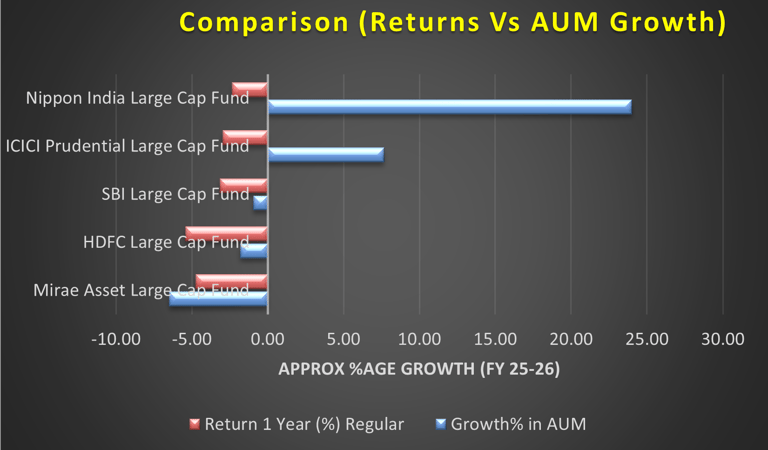
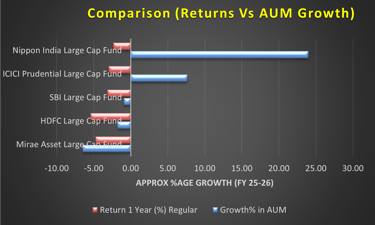
As it is clearly visible in the chart above, despite negative returns, the average AUM of these 5 Large Cap funds have been relatively stable. This clearly indicates the growing confidence of Investors and maybe migration of traders towards Investing. Four out of five Mutual Fund Schemes – Nippon India Large Cap Fund, ICICI Prudential Large Cap Fund, SBI Large Cap Fund, HDFC Large Cap Fund and Mirae Asset Large Cap Fund have shown a stable to Positive growth in AUM in FY26 despite negative returns.
A disciplined SIP investment (or SIP) allows you to invest regularly without worrying about daily fluctuations. You don’t need to time the market or stare at a trading screen all day.
More importantly, mutual funds help investors stay consistent even during corrections.
In fact, growing participation in Mutual Funds in India reflects rising investor maturity and confidence.
Why is a Mutual Fund Distributor important for Investors?
Many people assume Mutual Funds are simple; pick the best Mutual Fund online and start investing. But in reality, selecting the right fund is not only about returns. It requires understanding risk profile, time horizon, asset allocation, and the investor’s personal financial goals.
This is where a mutual fund distributor plays a very important role.
A good distributor does much more than just “Selling Funds.” They guide investors on:
Choosing the right type of Mutual Fund (equity, hybrid, debt)
Creating a proper portfolio instead of randomly buying funds
Building a disciplined SIP habit for long-term growth
Avoiding emotional decisions during market corrections
Staying invested when markets fall, which is the key to wealth creation
Most importantly, a distributor helps investors stay realistic. Many people enter the market expecting quick returns, like trading. But mutual funds work best when investors stay consistent over time.
When markets fall, many investors panic and stop SIPs. A distributor helps them understand that volatility is normal and long-term investing is the best investment approach.
So what is the best investment for beginners?
There is no universal “perfect” answer, but for most first-time investors, the best investment is the one that matches their risk appetite and keeps them invested for the long term.
Instead of chasing the best Mutual Funds based only on last year’s returns, investors should focus on goals: wealth creation, child education, retirement, or buying a home.
Final thoughts
Trading is not bad, but it is not easy. And in a volatile year, it becomes even harder. If 2026 remains uncertain, many traders may struggle emotionally and financially.
If you are new to markets, avoid treating the stock market like a casino. Understand risk, avoid excessive leverage, and consider starting with Mutual Funds through SIPs. In most real-life cases, long-term investing beats short-term speculation.
That is the real meaning of what investment is: growing wealth patiently, not chasing quick wins.
Disclaimer
Mutual fund investments are subject to market risks. Past performance is not indicative of future returns. This blog is intended solely for education and awareness and should not be treated as investment advice or a recommendation to buy or sell any mutual fund scheme. Investors are advised to read all scheme-related documents carefully and consult a Mutual Fund Distributor before making any investment decisions.