
Rebalancing with Purpose: Why Diversification Matters More After FY26- A Mutual Fund Distributor’s perspective on building a resilient Portfolio
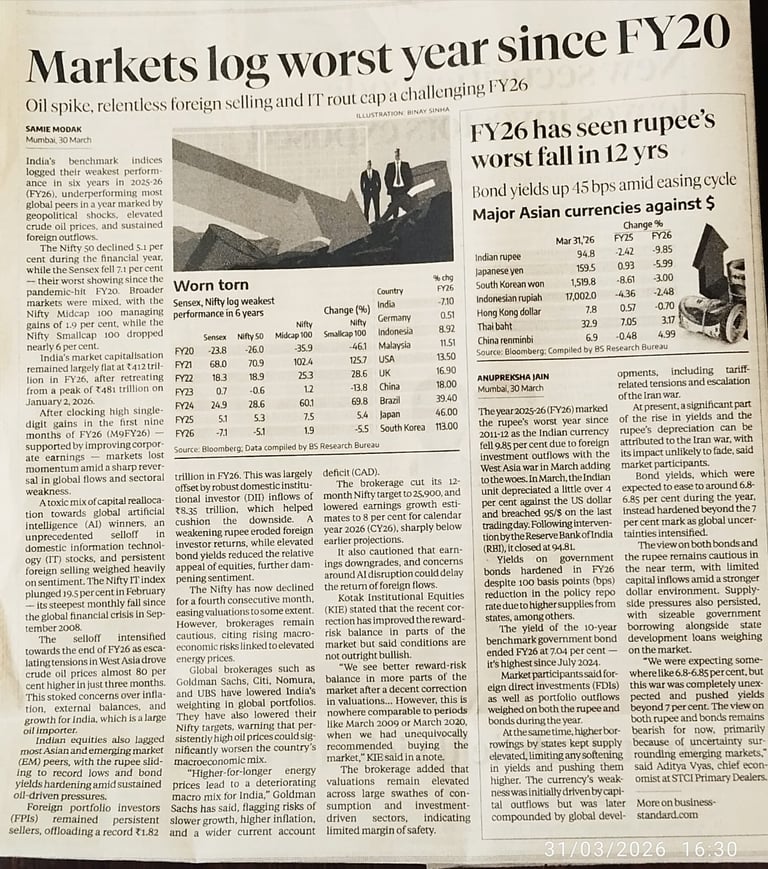
FY26 has been a reminder that equity investing is not about “always going up.” As highlighted in the Business Standard article, Indian markets witnessed their weakest performance since FY20. The Sensex declined 7.1% and the Nifty 50 fell 5.1%, driven by multiple factors such as crude oil spikes, persistent foreign selling, currency weakness, and global uncertainty.
TOP POSTSENGLISH
FY26 has been a reminder that equity investing is not about “always going up.” As highlighted in the Business Standard article, Indian markets witnessed their weakest performance since FY20. The Sensex declined 7.1% and the Nifty 50 fell 5.1%, driven by multiple factors such as crude oil spikes, persistent foreign selling, currency weakness, and global uncertainty.
For many investors, this year felt uncomfortable, not because markets fell (that is normal), but because portfolios were often positioned with heavy dependence on Indian equities alone. FY26 clearly demonstrated an important principle of investing:
Even strong economies can experience weak market years.
This is exactly why diversification is not just a buzzword; it is a practical strategy to reduce overdependence on one market cycle.
What FY26 Taught Us About Market Cycles?
Over the last few years, Indian investors have experienced strong rallies, especially in midcap and smallcap segments. But FY26 brought a sharp shift in sentiment. The year also saw the rupee register its worst fall in 12 years, which added pressure on foreign flows and impacted market confidence.
However, what is even more interesting is that while Indian indices struggled, many global markets performed better. This difference in performance across geographies is one of the strongest arguments for international exposure.
The Last Six Years: Indian Market Performance Has Been Uneven
The table from the article shows that Indian indices have delivered very different outcomes across financial years. FY21 and FY24 were exceptionally strong, while FY20 and FY26 were weak. Midcaps and smallcaps delivered higher upside in certain years but also faced deeper corrections.
This reinforces a crucial investing reality:
Market leadership rotates, and returns do not come evenly every year.
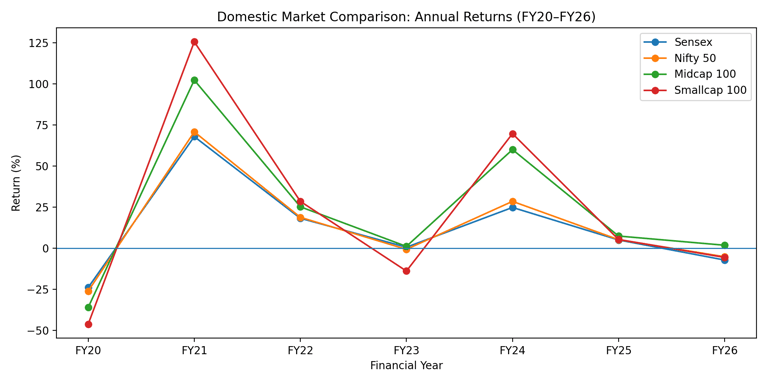
Chart 1: Indian Equity Indices – Annual Returns (FY20 to FY26)
A well-diversified investor typically avoids excessive concentration in a single segment. Instead, diversification across large caps, midcaps, and smallcaps helps in reducing the impact of sharp cycles.
India vs Global Markets in FY26: Diversification Advantage
One of the most important insights from the article is how Indian markets performed as compared to other markets in FY26.
While India’s Sensex declined 7.1%, several countries delivered positive returns, including the USA, UK, China, Brazil, Japan, and South Korea. This performance divergence is not unusual; different countries react differently to interest rates, inflation, geopolitics, currency changes, and earnings cycles.
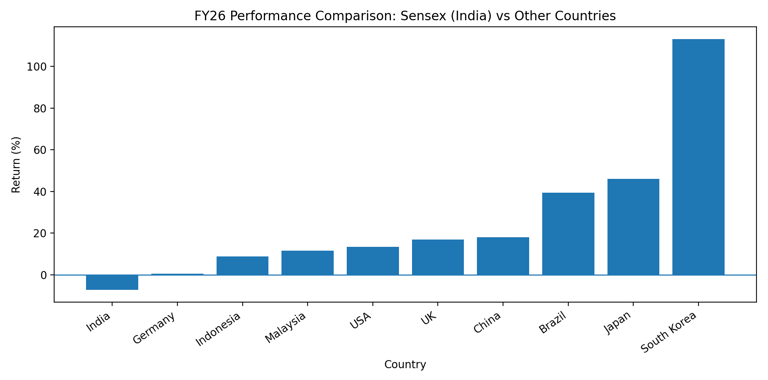
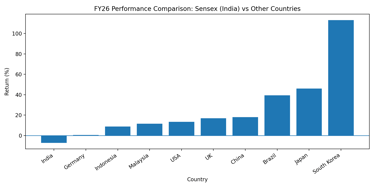
This chart highlights why international diversification is relevant. When one market underperforms, another may compensate and help stabilise overall portfolio outcomes.
How International Exposure Can Improve Portfolio Stability?
International investing does not mean shifting away from India. India remains one of the strongest long-term growth stories globally due to favourable demographics, rising consumption, infrastructure expansion, and digital adoption.
But even strong markets go through phases of:
Earnings slowdown
Valuation corrections
Foreign fund outflows
Sector underperformance
International exposure can help balance these phases because global markets do not always move in the same direction at the same time.
A small allocation to international markets may provide:
Exposure to global sector leaders
Diversification across economic cycles
Reduced reliance on Indian market performance alone
This is especially relevant today, when global innovation themes like AI, semiconductors, biotech, and large technology platforms are largely dominated by companies listed outside India.
Asset Allocation: The Real Driver of Long-Term Investing Discipline
Most investors focus heavily on product selection. But in reality, the bigger driver of long-term outcomes is asset allocation, the mix between equity, debt, and other asset classes, and the mix between domestic and international exposure.
FY26 is a strong example of why portfolios need balance. When equity markets correct, portfolios with a structured allocation (including debt and global exposure) often experience smoother volatility.
Asset allocation is not meant to eliminate corrections. Instead, it is meant to reduce the emotional stress investors face during downturns, helping them remain invested and avoid disruptive decisions.
How a Mutual Fund Distributor Can Add Value in Diversification
A mutual fund distributor is not just someone who facilitates transactions. The real value lies in providing structure, awareness, and long-term discipline.
A distributor can help investors by:
Explaining the importance of asset allocation
Ensuring portfolio diversification across market caps and sectors
Educating investors about global mutual fund opportunities
Guiding investors on the concept of rebalancing
Helping investors avoid overexposure to one theme or one asset class
Improving investor behaviour by reducing panic-driven decisions
Global mutual fund investing is still a developing awareness area in India. Many investors are either unaware of international options or believe global exposure is only for high-net-worth investors. In reality, international allocation is increasingly becoming a mainstream portfolio component, especially when done thoughtfully and in moderation.
A distributor’s role is to ensure that investors understand why global exposure exists and how it fits into long-term planning—without chasing performance or reacting emotionally to short-term news.
Conclusion: FY26 Was a Reminder, Not a Warning
FY26 does not mean Indian markets are unattractive. It simply proves that no market can outperform every year. For long-term investors, the goal is not to predict which country will do best next year, but to build a portfolio that can withstand multiple cycles.
A diversified approach with measured exposure to International markets can potentially improve stability, reduce volatility, and support long-term investing discipline.
For further reading on this theme, you may refer to my detailed perspective here:
“Rebalancing with Purpose: A Mutual Fund Distributor’s Perspective on Diversification and Smarter Investing”
Disclaimer: This blog is for educational and awareness purposes only. It does not constitute investment advice or a recommendation to buy or sell any financial product. Mutual fund investments are subject to market risks. Investors should read all scheme-related documents carefully and consult appropriate professionals where required.
Author of this Blog is an AMFI-Registered Mutual Fund Distributor. Click here to connect with him.