Why do the majority of Stock Market Traders in India Lose Money?
The excitement around the stock market today has attracted millions of Indians towards trading. With easy access to trading apps, advanced tools and real-time trading charts, many new participants believe that making money in the Indian stock market is quick and simple. However, the truth is very different. A majority of retail traders in India end up losing money instead of creating wealth. This highlights the importance of understanding the risks involved and exploring safer financial alternatives.
ENGLISHTOP POSTS
भाषा बदलने के लिए यहां क्लिक करें
One of the main reasons traders lose money is the lack of proper knowledge and discipline. Many beginners enter the market influenced by social media tips or the hype around market trends today. Instead of building a strategy, they rely on guesswork and emotions. Trading requires strong decision-making, risk management, and patience, but most individuals start trading without preparation.
Another major factor is emotional trading. When prices rise, traders fear missing out and buy at higher levels. When prices fall, panic leads them to sell at a loss. This cycle becomes common, especially in intraday trading, where decisions must be made quickly. Since markets are unpredictable, reacting emotionally often results in repeated losses.

The risks become even higher in option trading. Many people see options as a shortcut to earning large profits, but they often ignore the fact that options are complex financial instruments. Factors like time decay and leverage can wipe out capital quickly. Without deep understanding, traders using a trading platform for derivatives usually face losses, even if the market moves slightly against them.
Additionally, frequent buying and selling increase transaction costs such as brokerage fees, taxes, and charges. These costs may look small individually, but they reduce profits significantly over time. This is why even traders who occasionally make correct predictions may still struggle to generate consistent returns.
For most Investors, long-term wealth creation is better achieved through Mutual Funds rather than short-term trading. Mutual funds offer diversification, professional management, and a structured way to invest in the market. A mutual fund investment allows individuals to benefit from market growth without needing to constantly track trading charts or daily fluctuations in the stock market today.
Let me explain this to you through an example. Let us take all the Large Cap Mutual funds that have a vintage of more than 10 years and divide them into three categories.
Category A – Where annual regular returns in last 10 years (As on 31st March 2026) are between 9 % - 11 % - PGIM India Large Cap Fund, Taurus Large Cap Fund, LIC MF Large Cap Fund, JM Large Cap Fund, Franklin India Large Cap Fund, Groww Large Cap Fund and UTI Large Cap Fund
Category B – Where annual regular returns in last 10 years (As on 31st March 2026) are between 11 % - 12.5 % - DSP Large Cap Fund, Tata Large Cap Fund, Axis Large Cap Fund, Aditya Birla Sun Life Large Cap Fund, SBI Large Cap Fund, HSBC Large Cap Fund, Invesco India Largecap Fund, Bandhan Large Cap Fund, Kotak Large Cap Fund, Baroda BNP Paribas Large Cap Fund, Edelweiss Large Cap Fund and Mirae Asset Large Cap Fund
Category C – Where annual regular returns in last 10 years (As on 31st March 2026) are between 12.5 % - 13.88 % - HDFC Large Cap Fund, Canara Robeco Large Cap Fund, ICICI Prudential Large Cap Fund, Nippon India Large Cap Fund
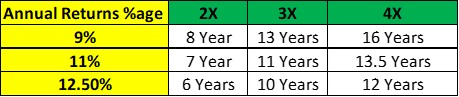
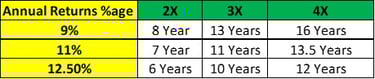
Now, let us check how compounding works at this rate of growth :
It is clearly visible that even if we take the lower slab (9%), money gets 4X (4 Times) in 16 years.
One of the most effective ways to invest in mutual funds is through a SIP (Systematic Investment Plan). A SIP investment helps investors invest small amounts regularly, which builds discipline and reduces the risk of timing the market. Over time, the power of compounding can create significant wealth. This compounding magic is what makes mutual funds one of the best investment options for long-term financial goals.
Choosing the best mutual fund can still be confusing for new investors, which is why the role of a Mutual Fund Distributor becomes extremely important. A distributor helps investors understand their risk profile, goals, and investment horizon, and guides them toward suitable funds. Their support ensures that investors stay consistent and avoid impulsive decisions.
In conclusion, while trading through a trading app may look attractive, the majority of traders lose money due to lack of strategy, emotional decisions, high-risk products, and transaction costs. For those seeking stable wealth creation, mutual funds offer a safer and smarter approach with the support of a trusted Mutual Fund Distributor.
Disclaimer
Mutual fund investments are subject to market risks. Past performance is not indicative of future returns. This blog is intended solely for education and awareness and should not be treated as investment advice or a recommendation to buy or sell any mutual fund scheme. Investors are advised to read all scheme-related documents carefully and consult a Mutual Fund Distributor before making any investment decisions.
Click here to connect with an AMFI-Registered Mutual Fund Distributor.